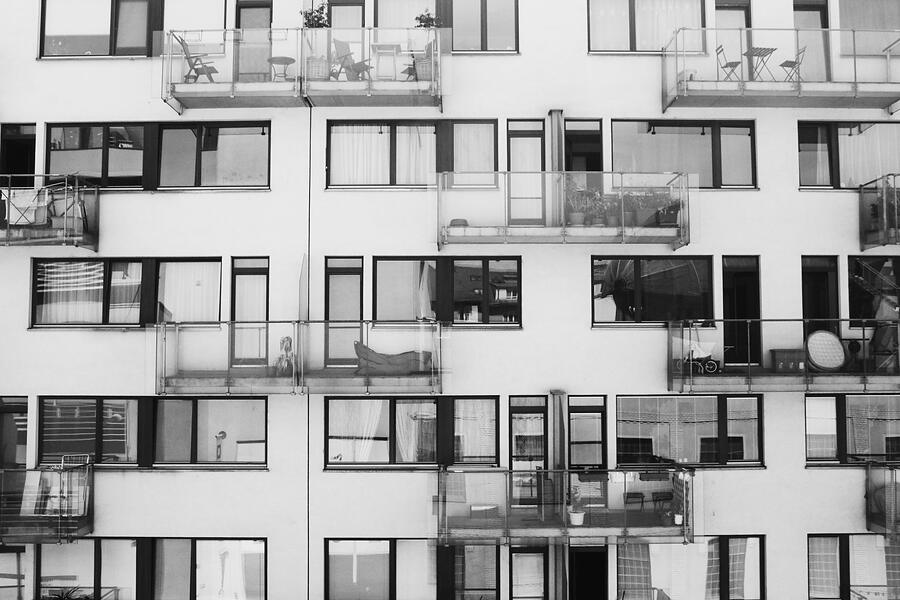
Apartment Security Guards in Downtown Orlando
Downtown residents live inside an entertainment district, in towers and mid-rises that stack a podium garage, a lobby and an amenity deck into one address with no gate and no perimeter. Nexus Security Firm staffs officers at those buildings on the hours the district hands them its overflow.
Apartment Security Guards in Downtown Orlando
A downtown building has no fence to defend. The ground floor is retail or a leasing lobby that opens onto a public sidewalk, the residential floors sit above a parking podium, and the only real access control in the whole structure is a gate arm at one vehicular entry and a fob reader on a set of glass doors. Everything beyond that is a city street, and on Friday night that street is the busiest bar district in Central Florida.
The city has spent several years tightening the district around those residents. Bars and nightclubs downtown now need a permit to serve alcohol after midnight, the code sets a 300-foot separation between nightlife venues, and the phased reopening of Orange Avenue came with added safety measures and attention to private parking lots. None of that changes what happens at two in the morning when several thousand people leave at once and walk back through blocks where people live.
The residential stock keeps growing into that. Society Orlando added a 28-story residential tower in 2023, a $102 million project on Church and Mariposa streets in Thornton Park is planned as a 10-story building of 200 units and a 12-story building of 310 units over 30,000 square feet of ground-level retail, and UnionWest at Creative Village holds 640 student beds in a $105 million tower alongside the UCF Downtown and Valencia College downtown campuses. Vertical residential in a nightlife district is a specific security problem, and it is the one this page is about.
The hours that carry the incidents run from midnight to four
Ask a downtown manager when the problems happen and the answer comes back as a window of hours.
The load arrives with the let-out. People who have been drinking look for a bathroom, a place to sit and a way home, and a residential lobby with a couch visible through glass is the most inviting thing on the block. Garage entries get walked through behind a resident's car. Stairwells off the street level get used. Rideshare pickup turns the porte-cochere into a crowd for ninety minutes. Residents coming home on foot at that hour are the people most likely to be followed to their own door.
Coverage that works downtown is narrow and late. Thursday through Saturday from around ten at night to four in the morning covers most buildings' entire incident history, and a property that buys eight hours starting at eight in the evening has paid for the quiet half and gone unstaffed for the loud one. The first thing we ask for is the log, because downtown logs are unusually clear about which nights and which hours carry the load.
The podium garage is the building's weakest point
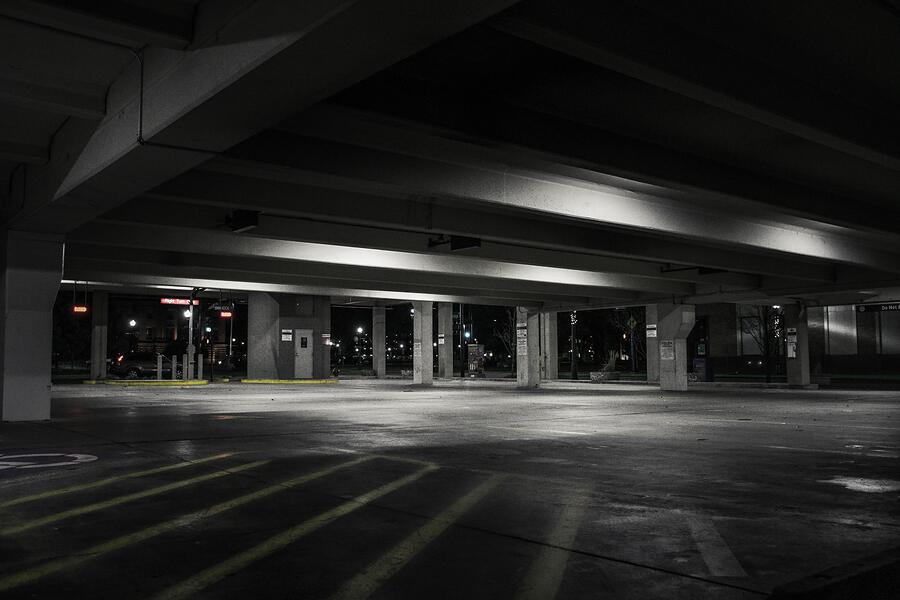
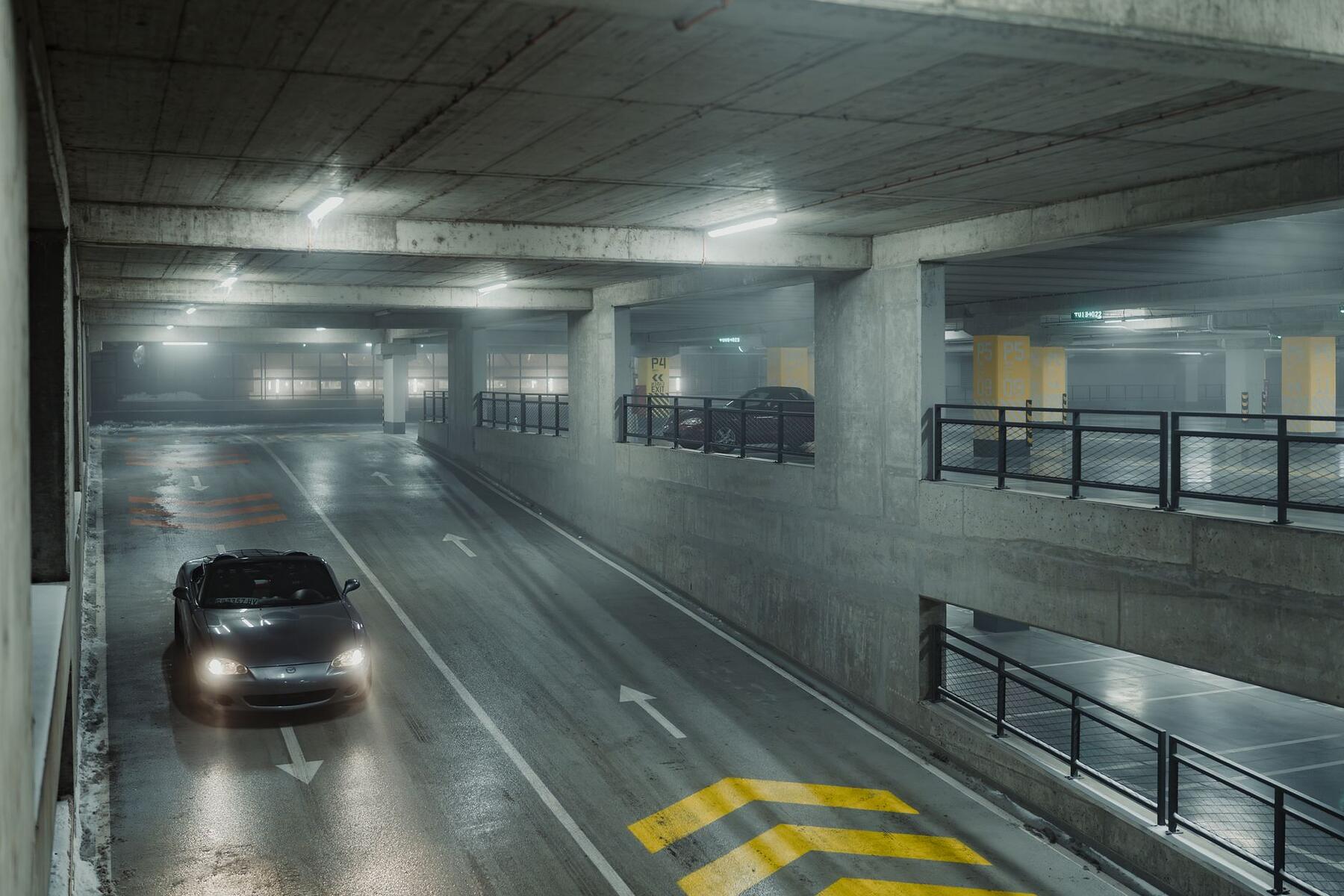
A downtown garage sits inside the building, which means every access failure in it is already past the perimeter.
There is usually one vehicle entry with an arm, and the arm holds for a few seconds after a resident's transponder reads, which is enough time for a second car and for anyone on foot. Stair doors connect the decks to the street and to the residential elevator lobby, and a door that stops latching turns the whole stack into an open building. The upper decks are the quietest space in a dense neighborhood at three in the morning, which is why they collect people who have nowhere else to be, and why vehicles parked all weekend get opened up there.
An officer working the deck levels on an unpredictable pattern, checking stair door latches, and standing at the arm during the hours the district empties is the whole job on most downtown properties. The round is recorded, so when a resident reports a vehicle entered on Saturday night the office starts a camera pull from a time instead of from a weekend.
Lobby and parcel volume in a building with no front gate
Downtown buildings concentrate deliveries the way no garden property does, and they do it behind one door on a public street.
Food couriers, package carriers and rideshare drivers arrive all evening and every one of them needs to get through the same glass. Residents let them in. Doors get propped for a delivery and stay propped for an hour. A parcel room holding a whole tower's packages behind a single fob reader is a concentrated target, and the reports come in days late because people order constantly and notice slowly.
A lobby post changes the calculation for anyone deciding whether to walk in behind somebody. Officers hold the entry during the heavy delivery hours, record arrivals and departures at the parcel room, walk out residents who ask, and handle the person who has come in off the sidewalk to sleep on the lobby furniture. That last one is the most common single call at street-level downtown buildings, and it is the one leasing staff should never be handling alone at eleven at night.
Student beds and mixed-income floors change the post orders
Downtown holds several resident populations at once, and two buildings on the same block can need opposite schedules.
The Creative Village side carries student beds tied to the UCF Downtown and Valencia downtown campuses, which puts an academic calendar and a guest problem into a neighborhood otherwise driven by nightlife. Elsewhere downtown, buildings mix market-rate floors with units allocated to affordable housing programs, and the practical effect for a manager is a wider range of schedules, more foot traffic through the lobby at odd hours, and a stronger argument for coverage that residents can see.
Post orders get written to the building rather than to the district. A student-heavy address needs guest control at the amenity deck and a turn-week plan. A conventional tower needs the garage and the lobby on weekend nights. Writing one set of orders and using it on both is how a property ends up paying for an officer standing in the wrong place.
Where an officer stands in a downtown building
On most downtown properties the officer alternates between three places. The lobby during the delivery hours and again at the let-out, where the glass doors face the sidewalk. The garage arm at the hours cars are coming home in volume, which is the only time tailgating through it matters. And the deck levels and stairwells on a rotating pattern the rest of the shift, working from the top down on some rounds and the bottom up on others so the timing cannot be learned from a parked car. The amenity deck on the podium roof gets closed at posted hours and checked after.
Why downtown Orlando managers use Nexus Security Firm
-
Hours matched to the district clock
Downtown coverage sold in eight-hour blocks starting at six in the evening spends most of its cost on hours nothing happens in. We read the building log first and write the schedule against it, which downtown usually means a late window on three or four nights. Where a property would get more from five hours placed correctly than from eight placed conveniently, that is what we quote, and we will say so before the contract is signed.
An hour costs 1.5 to 2 times the officer wage (Belfry Software, 2026), so placement is the budget.
-
Supervision on the shift nobody else attends
The downtown shift is the one that ends at four in the morning, and it is the one where guard companies are least likely to have anyone checking. A supervisor is assigned to every post we staff and attendance includes those hours. The sleeping-on-post stories in this industry trace back to officers absorbing doubles because relief was never arranged, so scheduling and supervision are the same problem in practice.
Turnover across the security trade ran at 77% during 2024 (ASIS International).
-
A licensed agency and officers you can look up
Downtown owners and asset managers ask for the license before they ask for the rate. Nexus Security Firm holds FDACS Class B agency license B 1900066, our officers hold Class D licenses, and armed posts add a Class G. Every one of those numbers sits on the FDACS Division of Licensing public lookup. Ask any company quoting your building for its agency number in writing and search it, because describing yourself as licensed costs nothing.
Florida puts 40 hours of FDACS-approved training behind every Class D officer license.
A typical call from a downtown Orlando building
The situation: A common call from a manager at a mid-rise a few blocks off Orange Avenue. Three vehicles were entered on the upper decks of the garage across two weekends, someone has been sleeping in the ground-floor stairwell, and on Sunday morning the leasing team keeps finding the lobby furniture occupied by people who do not live in the building. Residents are emailing the regional.
What gets done: A supervisor walks the property at midnight on a Friday. The garage arm is holding long enough for two cars, one street-level stair door has stopped latching, and the top deck has no lighting on its south half. Coverage is written for Thursday through Saturday on the late hours, unarmed, with the officer alternating between the lobby, the arm and the deck levels on an irregular pattern. Post orders cover what the officer does with a person asleep in the stairwell, when Orlando police are called, and how a resident escort is requested. The door latch and the lighting go on a repair list that goes to the office the same week.
How it turns out: The repairs close two of the three ways people were getting in, which is work no amount of guard hours would have replaced. The garage entries stop clustering on the top deck once the round pattern stops being readable. Vehicle reports that do come in now arrive with a round log beside them, so the camera pull starts from a window instead of a weekend, and the office has a dated record to hand the owner when the quarterly question comes.
Questions downtown Orlando managers ask
The questions that come up when a building has a garage, a lobby and a bar district for a perimeter.
Other areas we cover communities
Communities in the surrounding areas share the same officers, which keeps an overnight post from depending on one person being available.